(+1) 88 700 600
310 West 14th North Street, NY
Synthesis and processing form the foundational pillar of IRC NANO, underpinning all other research areas. Our work in this domain spans two interconnected activities: the targeted synthesis of nanoparticles – controlled by shape, size, crystallinity, chirality, and chemical composition – and their assembly and consolidation into complex structures and bulk materials.
A key insight driving our approach is that the quality of functional nanomaterials depends critically on the precision of their starting components. Most commercially available nanopowders are polycrystalline, agglomerated, and poorly distributed in size – limitations that constrain their performance in advanced applications. We therefore focus on synthesising single-crystal nanoparticles with defined characteristics, an approach that unlocks significant advantages across our research in ionics, photonics, and ferroics.
Chirality is a particularly exciting frontier in this space. Chiral nanostructures exhibit unique chemical and physical properties that can be tuned by circularly polarised electromagnetic fields, and the field is rapidly expanding across metals, semiconductors, ceramics, and nanocarbons. Understanding and harnessing chiral asymmetry in the context of ionics, ferroics, and photonics remains largely uncharted territory – and one we are actively exploring.
On the processing side, our focus is on advanced consolidation techniques that preserve the nanoscale grain structure of materials – typically in the 1–50 nm range – while achieving high density. We have pioneered work in cold sintering, laser sintering, field-assisted sintering, and magnetically guided self-assembly, achieving grain sizes of 40-80 nm in fully dense materials at temperatures below 350°C. These low-temperature techniques are particularly significant for the production of ceramics and ceramic/polymer composites, where conventional high-temperature methods would otherwise destroy the very nanostructural features that give these materials their properties.
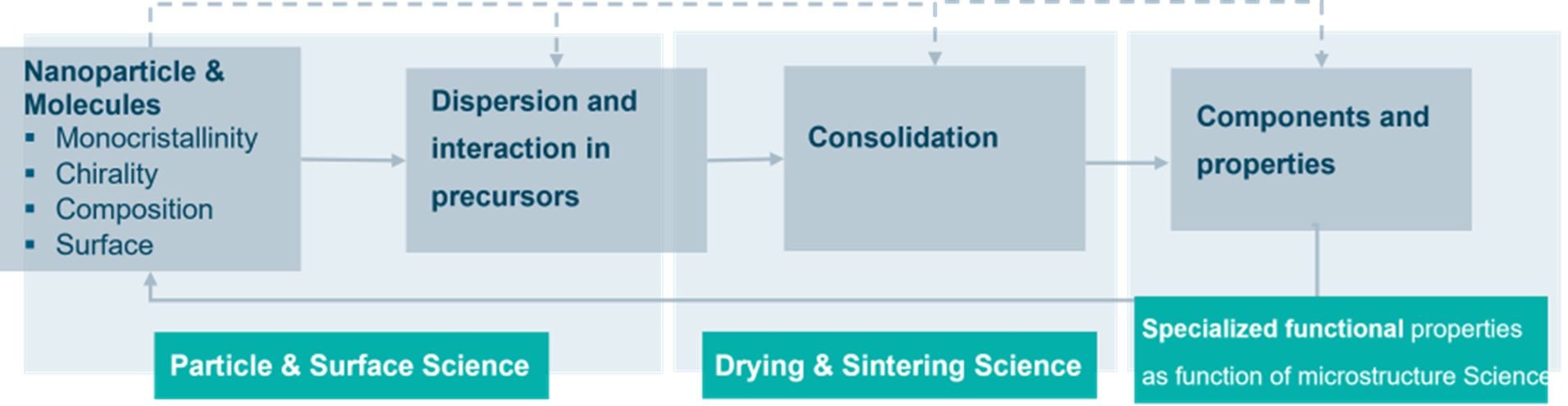
Underpinning all of this is multiscale modelling, including Molecular Dynamics simulations, which allow us to predict nanoparticle assembly behaviour and understand the kinetics of structural transformations at the atomic level – enabling more precise, knowledge-driven control over the entire synthesis and processing pipeline.
© 2026 IRC NANO. All rights reserved